

Linux is widely used across enterprise servers, cloud environments, data centers, and critical IT infrastructures. Known for its reliability, stability, and open-source architecture, Linux plays an essential role in modern computing environments. However, like any operating system, it is not immune to security vulnerabilities.
A recently disclosed vulnerability, identified as CVE-2026-98432, has raised significant concerns among Linux system administrators and cybersecurity professionals.
With a CVSS 3.1 score of 9.8 (Critical), this vulnerability affects how the Linux kernel manages memory during TCP connection processing. Under certain conditions, an attacker can trigger the vulnerability remotely through specially crafted network traffic without requiring authentication or user interaction.
The severity of the issue became even more apparent on October 27, 2026, when Anthropic published research demonstrating that the vulnerability could be exploited to execute commands with root privileges on certain Linux servers.
But what exactly causes this vulnerability? Which Linux distributions are affected? And most importantly, what can system administrators do to protect their infrastructure?
In this article, we will explore CVE-2026-98432, explain how it works, review its impact on major Linux distributions, and discuss practical steps to identify and reduce the associated risks.
Note: The distribution-specific patch information in this article is based on the source report dated October 30, 2026. Administrators should always consult official vendor security advisories for the latest information.

What Is CVE-2026-98432, and Why Is It Important?
CVE-2026-98432 is a memory management vulnerability found in the IPv4 TCP connection-handling functionality of the Linux kernel.
The vulnerability belongs to a category of memory safety issues known as Use-After-Free (UAF).
Although the term may sound complicated, the underlying problem is relatively straightforward.
When an operating system or application needs to process information, it temporarily allocates memory to store that data. Once the information is no longer required, the allocated memory is released so that it can be reused by other processes.
However, software defects can sometimes cause a program to continue accessing memory after it has already been released.
When this happens, the program may read outdated information, access invalid data, or interact with memory that has already been assigned to another process.
Depending on the circumstances, this can lead to unexpected system behavior, memory corruption, information disclosure, or even unauthorized code execution.
CVE-2026-98432 is caused by this type of memory management error.
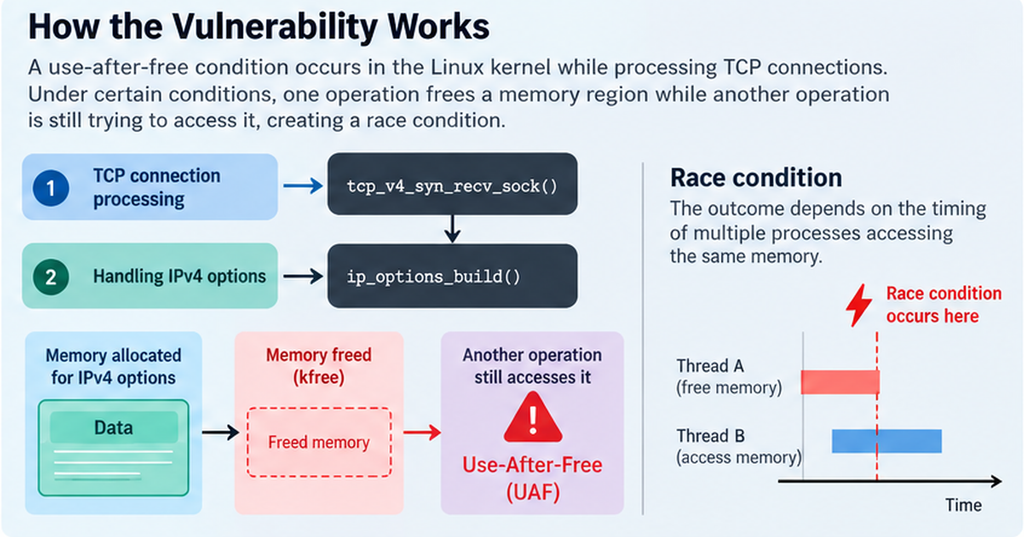
The issue occurs when different parts of the Linux kernel process TCP connection requests simultaneously. Under specific conditions, one operation can release a memory region while another operation is still attempting to access it.
This creates what is known as a race condition.
A race condition occurs when the outcome of an operation depends on the timing of multiple processes or threads accessing shared resources.
In this case, an attacker may be able to influence that timing through specially crafted network packets.
What makes this vulnerability particularly concerning is that it affects the Linux kernel itself.
Unlike a vulnerability limited to a particular application, a kernel-level vulnerability can potentially compromise the security and stability of the entire operating system.
If successfully exploited, it may allow an attacker to interfere with critical system operations and, under certain conditions, gain elevated privileges.
How Does the Vulnerability Affect TCP Connections?
To understand how CVE-2026-98432 works, it is helpful to briefly review how TCP connections are established.
When a client attempts to connect to a service running on a Linux server, the communication begins with a process known as the TCP three-way handshake.
This process consists of three steps:
- The client sends a SYN packet to initiate a connection.
- The server responds with a SYN-ACK packet.
- The client sends an ACK packet to complete the connection.
Under normal circumstances, this process happens quickly and reliably.
However, network packets may occasionally be retransmitted, and multiple CPU cores may process operations associated with the same connection simultaneously.
This is where CVE-2026-98432 becomes relevant.
The vulnerability involves two Linux kernel functions:
tcp_v4_syn_recv_sock()ip_options_build()
These functions participate in processing incoming TCP connections and handling IPv4 options.
Under certain circumstances, they can access the same memory region while processing related connection requests.
One operation may release memory containing IPv4 options before another operation has finished reading the information stored there.
As a result, the kernel may attempt to access memory that is no longer valid.
Such behavior can cause more than a failed network connection. Depending on how the released memory is reused, it may lead to information disclosure, memory corruption, or a system crash.
To address the issue, Linux kernel developers introduced a change that delays memory reclamation using the kfree_rcu() mechanism rather than immediately releasing the affected memory through kfree().
This approach relies on the Read-Copy-Update (RCU) synchronization mechanism, allowing existing readers to complete their operations before the memory is safely reclaimed.
The objective is to prevent the kernel from accessing memory that has already been freed.
What Could an Attacker Achieve?
One of the most concerning characteristics of CVE-2026-98432 is that it can be triggered remotely under suitable conditions.
An attacker does not necessarily need an existing account on the affected server.
Instead, the vulnerability can potentially be reached through network traffic sent to a listening IPv4 TCP service.
The potential consequences can be divided into three main categories.
Information Disclosure
An attacker may be able to obtain information from memory regions that have already been released.
This information could reveal details about the Linux kernel’s memory layout or other internal structures.
Such information may be valuable when attempting to bypass memory protection mechanisms or develop more advanced exploitation techniques.
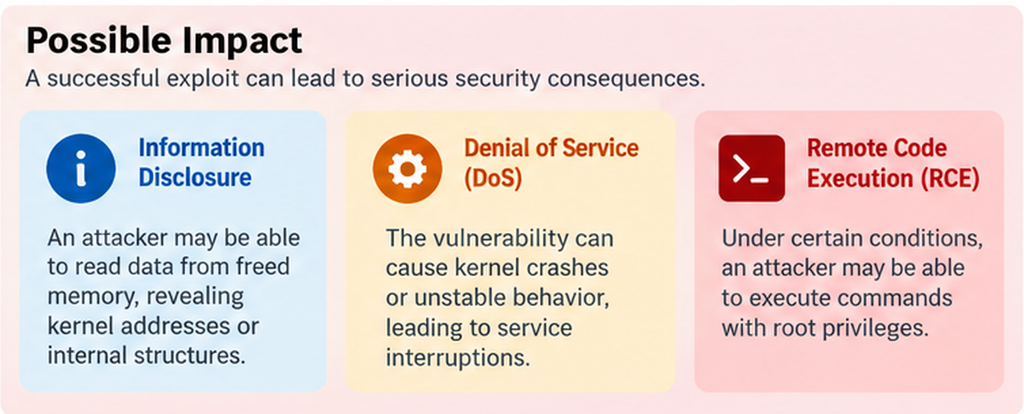
Denial of Service (DoS)
The vulnerability can also cause the Linux kernel to behave unexpectedly or crash.
For organizations running critical applications, a kernel crash can result in service interruptions, application downtime, and operational disruption.
Systems that support business-critical workloads may be particularly sensitive to unexpected outages.
Remote Code Execution (RCE)
The most serious potential outcome is unauthorized code execution.
Under certain conditions, an attacker may be able to manipulate kernel memory and alter the execution flow of the operating system.
A successful exploit could allow commands to run with root privileges, potentially giving the attacker extensive control over the affected system.
However, it is important to understand that not every vulnerable Linux server can necessarily be compromised using the same technique.
Successful exploitation depends on the kernel version, system configuration, available network functionality, and other technical conditions.
Nevertheless, the possibility of kernel-level code execution makes this vulnerability a significant security concern.
Anthropic Research: Demonstrating Root-Level Code Execution
On October 27, 2026, Anthropic published research that provided additional insight into the practical impact of CVE-2026-98432.
According to the research, an unreleased internal Claude research model was used to develop a working exploit targeting the vulnerability.
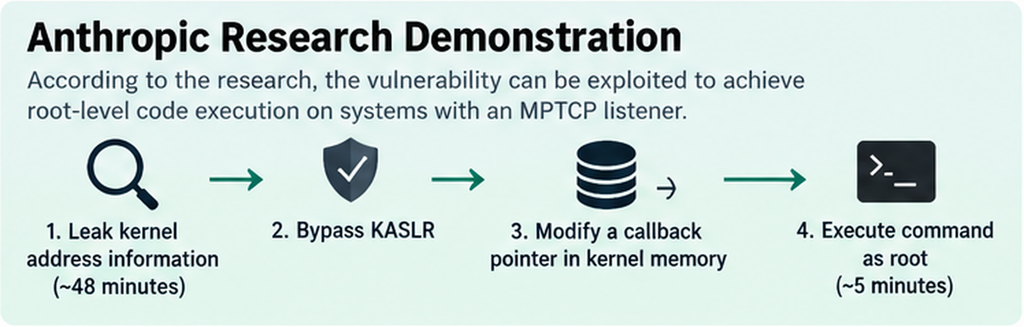
The demonstration involved Linux servers configured with a Multipath TCP (MPTCP) listener.
Multipath TCP is an extension of traditional TCP that allows supported systems to use multiple network paths within a single logical connection.
This can improve connection resilience and make better use of available network interfaces.
In the reported demonstration, the exploit first obtained information about a kernel memory address.
This information was then used to overcome Kernel Address Space Layout Randomization (KASLR), a security mechanism designed to make memory-based exploitation more difficult.
The researchers subsequently demonstrated that they could modify a callback pointer in kernel memory and execute a command with root privileges.
According to the published test results, obtaining the kernel address information took approximately 48 minutes, followed by another five minutes to achieve command execution.
These findings demonstrated that the vulnerability was not merely a theoretical concern.
Under specific conditions, it could be turned into a working exploitation technique with serious security implications.
However, Anthropic did not publicly release the exploit code.
As of October 30, 2026, the source report also noted that no vendor had confirmed exploitation in the wild and that the vulnerability had not been added to the CISA Known Exploited Vulnerabilities (KEV) catalog.
A successful research demonstration should therefore be distinguished from confirmed exploitation in real-world attacks.
Even so, organizations should treat the issue seriously and prioritize appropriate security measures.
Why Do Vendors Assign Different CVSS Scores?
An interesting aspect of CVE-2026-98432 is that different Linux vendors have assigned different severity scores to the same vulnerability.
For example, the Linux Kernel CVE team and Ubuntu rate the vulnerability as Critical with a CVSS 3.1 score of 9.8.
SUSE and Amazon Linux assign a score of 8.1, while Red Hat’s assessment in the source report is 5.9.
| Vendor or Source | CVSS Score | Severity |
|---|---|---|
| Linux Kernel CNA | 9.8 | Critical |
| Ubuntu | 9.8 | Critical |
| SUSE | 8.1 | High |
| Amazon Linux | 8.1 | Important |
| Red Hat | 5.9 | Moderate (draft) |
The differences primarily come from how vendors evaluate attack complexity and potential impact.
Some vendors consider the timing requirements of the race condition difficult to exploit reliably.
Others take into account the attacker’s ability to repeatedly trigger the condition until exploitation succeeds.
There are also differences in how vendors assess the practical consequences.
For instance, Red Hat’s assessment focuses more heavily on availability impacts, while other assessments include potential confidentiality and integrity violations.
For system administrators, the important lesson is that a CVSS score should not be the only factor used to determine patching priorities.
A vulnerability rated as moderate by one vendor may still represent a serious concern in a particular environment.
Internet-facing Linux servers, systems running critical applications, and infrastructure handling sensitive information should all be evaluated according to their actual exposure and business importance.
Which Linux Kernel Versions Are Affected?
The underlying issue associated with CVE-2026-98432 dates back to Linux kernel version 4.4.
As a result, multiple generations of Linux kernel releases may be affected.
The Linux kernel maintainers have incorporated security fixes into several upstream stable branches.
The following table lists the first fixed releases identified in the source material.
| Linux Kernel Branch | First Fixed Version |
|---|---|
| 5.10 | 5.10.272 |
| 5.15 | 5.15.223 |
| 6.1 | 6.1.190 |
| 6.6 | 6.6.159 |
| 6.12 | 6.12.113 |
| 6.18 | 6.18.56 |
| 7.2 | 7.2.10 |
| Mainline | 7.3 |
However, there is an important distinction between upstream kernel releases and kernels supplied by Linux distributions.
Enterprise Linux vendors such as Ubuntu, Red Hat, and SUSE frequently maintain their own kernel packages.
Rather than upgrading directly to a newer upstream kernel, they often incorporate individual security fixes into their existing kernel versions.
This process is known as backporting.
Consequently, comparing the version reported by uname -r against the upstream version table is not always enough to determine whether a system is vulnerable.
A reliable assessment requires reviewing the security advisory published by the relevant Linux distribution.
Patch Availability Across Major Linux Distributions
As of October 30, 2026, Linux vendors were at different stages of releasing fixes for CVE-2026-98432.
Some distributions had already published updated kernel packages, while others were still preparing or deferring their fixes.
Ubuntu
According to the source report, fixes for Ubuntu 22.04 LTS, 24.04 LTS, 26.04 LTS, and 26.10 were still in progress.
The relevant updates had not yet been released at the time of the assessment.
Older releases, including Ubuntu 20.04, 18.04, and 16.04, were also listed as vulnerable without announced fixed package versions.
Ubuntu uses different kernel packages for its standard installations and cloud-specific environments such as AWS, Azure, Google Cloud, and Oracle Cloud.
Therefore, administrators should confirm the exact kernel package installed on each system rather than relying only on the Ubuntu release number.
Official advisory:
https://ubuntu.com/security/CVE-2026-98432
Red Hat Enterprise Linux, Rocky Linux, and AlmaLinux
Red Hat listed the fix for RHEL 8, RHEL 9, and RHEL 10 as deferred.
The assessment also covered certain real-time kernel packages and Red Hat CoreOS systems used by OpenShift.
RHEL 7 was classified as not affected.
Administrators using Rocky Linux and AlmaLinux should monitor the security advisories provided by their respective distributions.
Although these platforms are closely aligned with the Red Hat ecosystem, security updates are not necessarily published at exactly the same time.
Official Red Hat advisory:
https://access.redhat.com/security/cve/CVE-2026-98432
Debian
Debian was among the distributions with fixed kernel packages available.
The source report identified the following versions:
| Debian Release | Fixed Kernel Package |
|---|---|
| Debian 13 Trixie | 6.12.113-1 |
| Debian 12 Bookworm | 6.1.190-1 |
| Debian 12 with backported 6.12 kernel | 6.12.113-1~deb12u1 |
For these security updates to be installed, the appropriate Debian security repositories must be configured.
Administrators can generally update package information and install available updates using:
sudo apt update
sudo apt upgrade
If a new kernel is installed, the system should be restarted during an appropriate maintenance window.
Official Debian security tracker:
https://security-tracker.debian.org/tracker/CVE-2026-98432
Amazon Linux
For Amazon Linux 2023, the patch status depends on the kernel package being used.
According to the source report, security fixes were released for the optional kernel6.18 and kernel6.12 packages.
However, the default Amazon Linux 2023 kernel package and Amazon Linux 2 were still awaiting fixes.
This distinction is particularly important in AWS environments, where EC2 instances may use different kernel packages even when running the same Linux distribution.
Administrators should verify the installed package and review the corresponding Amazon Linux security advisory.
Official advisory:
https://explore.alas.aws.amazon.com/CVE-2026-98432.html
SUSE Linux Enterprise Server
SUSE released updated kernel packages for several supported versions, including SLES 16.0 and selected SLES 15 Long-Term Service Pack Support (LTSS) releases.
Additional fixes were also available for certain SLE Micro versions.
However, the source report indicated that work on SLES 15 SP7 was still in progress.
Administrators should verify the security status of their specific SUSE release and kernel package.
Official advisory:
https://www.suse.com/security/cve/CVE-2026-98432.html
Oracle Linux
Oracle Linux released security updates for its Unbreakable Enterprise Kernel (UEK) on October 16, 2026.
The updates covered Oracle Linux 7 through Oracle Linux 10, according to the source report.
However, Oracle Linux can also use the Red Hat Compatible Kernel (RHCK).
Systems running RHCK should be evaluated against the appropriate RHCK security advisories rather than assuming that UEK updates apply to them.
Official advisory:
https://linux.oracle.com/cve/CVE-2026-98432.html
Overall, the patch status of CVE-2026-98432 demonstrates why organizations should track vulnerabilities at the distribution and kernel-package level.
There is no single kernel version or update procedure that applies universally to every Linux environment.
How to Check Whether Your Linux Server Is Affected
The first step in evaluating exposure is identifying the Linux distribution and the kernel version currently running on the server.
Start by checking the operating system information:
cat /etc/os-releaseThis command displays the distribution name, version, and related identification details.
Next, check the active kernel version:
uname -rThis returns the kernel version currently running in memory.
However, the version number alone does not prove whether the vulnerability has been fixed.
The result must be compared with the relevant vendor security advisory, taking into account any backported security fixes.
Checking Ubuntu and Debian Systems
On Ubuntu and Debian, administrators can search the kernel package changelog for the CVE identifier.
apt changelog linux-image-$(uname -r) 2>/dev/null | grep CVE-2026-98432This command attempts to identify whether the currently running kernel package includes a changelog entry referencing the vulnerability.
It is also useful to check whether the system requires a restart:
[ -f /var/run/reboot-required ] && echo "Reboot required"If the reboot-required file exists, the command displays a notification.
However, the absence of a matching changelog entry does not automatically mean that the system is vulnerable.
Some distributions may use different package names or document security fixes through separate advisories.
Checking RHEL, Rocky Linux, and AlmaLinux
On RPM-based systems, administrators can inspect the kernel package changelog.
rpm -q --changelog kernel-$(uname -r) | grep CVE-2026-98432Depending on the distribution and kernel variant, the package name may need to be adjusted.
To check whether a restart is required, use:
needs-restarting -rThe command may require the appropriate system utilities package to be installed.
Checking SUSE Linux Enterprise Server
On SUSE systems, the kernel package changelog can be examined using:
rpm -q --changelog kernel-default | grep CVE-2026-98432If the system uses a different kernel package, the command should be modified accordingly.
These checks provide a useful starting point, but they should not be treated as a complete vulnerability assessment.
The most reliable approach is to verify the exact kernel package against the distribution’s published security advisory and confirm that the fixed kernel is actually running.
What Should You Do If a Security Patch Is Not Available?
Not every Linux vendor releases security updates at the same time.
For organizations using distributions where a fix has not yet been published, it may be necessary to implement temporary security measures.
These measures can help reduce exposure, but they do not eliminate the underlying vulnerability.
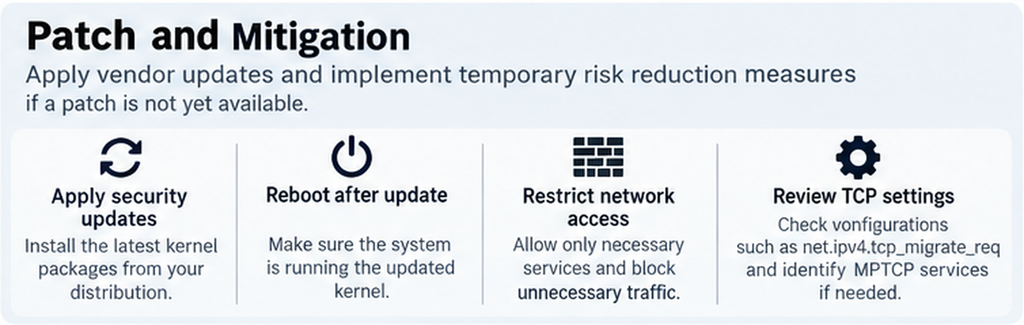
Check the TCP Request Migration Configuration
One of the recommended checks is to determine whether TCP request migration is enabled.
Run:
sysctl net.ipv4.tcp_migrate_reqThe expected default value is:
net.ipv4.tcp_migrate_req = 0Keeping this setting disabled limits a secondary path associated with the vulnerability.
However, it does not prevent the main IPv4 TCP vulnerability from being triggered.
Identify Services Using Multipath TCP
The exploit demonstrated in the Anthropic research targeted systems with an MPTCP listener.
For this reason, identifying services that use MPTCP can help administrators better understand their exposure.
Use the following command:
ss -MlnpThis command can be used to list listening MPTCP sockets.
It is particularly useful when reviewing applications that may automatically take advantage of MPTCP support.
However, disabling MPTCP should not be considered a complete solution.
The underlying vulnerability exists in the standard IPv4 TCP processing path, so systems without MPTCP cannot automatically be considered safe.
Restrict Unnecessary Network Access
Another important precaution is to review which TCP services are accessible from external networks.
Internet-facing servers should expose only the ports and services that are genuinely required.
Administrators should consider restricting access through network firewalls, host-based firewall rules, and appropriate network segmentation.
Reducing unnecessary network exposure can limit the opportunities available to an attacker.
The source report also discusses filtering certain IPv4 options that may be involved in triggering the vulnerability.
For example, the following nftables rule can be used to drop packets containing the IPv4 Record Route option:
nft add rule inet filter input ip option rr exists dropThis is only an example and should not be applied blindly.
The specified nftables table and chain must exist, and the rule does not cover every potential trigger associated with the vulnerability.
It also does not filter the IPv4 Timestamp option.
Firewall changes should always be tested before deployment to production systems to avoid disrupting legitimate application traffic.
Monitor Kernel Error Logs
Certain attempts to trigger this vulnerability may result in kernel errors or crashes.
Administrators can review kernel-related log messages using:
journalctl -kFor more targeted investigation, the following command searches for functions associated with the vulnerability:
journalctl -k | grep -E 'ip_options_build|ip_build_and_send_pkt|skb_under_panic'These logs may help identify unusual kernel behavior.
However, finding a matching error does not necessarily prove that an attack occurred.
Likewise, the absence of relevant error messages does not guarantee that the system has not been targeted.
Kernel logs should be evaluated alongside network monitoring, security alerts, and other available evidence.
Why Rebooting After a Kernel Update Matters
One of the most common issues in Linux patch management is installing a kernel update without restarting the server.
Unlike many application updates, kernel updates generally require the operating system to boot into the newly installed kernel.
For example, a security update may successfully install a new kernel package, but the server may continue running its previous kernel until the next reboot.
In this situation, the updated kernel exists on disk while the vulnerable kernel remains active in memory.
As a result, the system may appear updated even though it is still exposed to the vulnerability.
This is why kernel patching should include more than simply installing updates.
A complete process involves reviewing the vendor advisory, installing the appropriate kernel package, restarting the system when required, and verifying the active kernel afterward.
Following a reboot, administrators should run:
uname -rThe output should then be checked against the version or package identified as fixed by the relevant Linux vendor.
In environments using supported live kernel patching technologies, a reboot may not always be required for a specific vulnerability.
However, administrators must confirm that the livepatch provider actually supports and has successfully applied the fix for CVE-2026-98432.
A livepatch should never be assumed to exist simply because a system supports live kernel patching.
Managing the Vulnerability Across Enterprise Linux Environments
Checking a handful of Linux servers manually may be manageable.
However, the situation becomes much more challenging when an organization operates dozens or hundreds of Linux systems.
Different servers may run different distributions, kernel versions, and cloud-specific packages.
For example, an enterprise environment might contain Ubuntu application servers, RHEL database servers, Debian infrastructure systems, and Amazon Linux instances running in AWS.
Each platform may require different security updates and maintenance procedures.
As a result, effective vulnerability management requires a centralized and accurate inventory.
Organizations should maintain information such as server identification, Linux distribution, active kernel version, installed kernel packages, pending security updates, reboot requirements, and patch verification status.
Without this visibility, it becomes difficult to determine which systems remain exposed.
This is where centralized patch management solutions can provide significant value.
Tools such as PatchMon, discussed in the original source report, can help administrators monitor package versions, identify outstanding security updates, and determine whether systems need to be restarted.
For example, if a new kernel package has been installed but the server has not yet rebooted, a centralized management platform can flag the system for further action.
This allows IT teams to distinguish between systems that have downloaded or installed updates and systems that are actually running a fixed kernel.
For security teams, the goal is to answer an essential operational question:
Which Linux servers in our infrastructure are still running a kernel affected by CVE-2026-98432?
Being able to answer that question quickly and accurately is a major part of effective vulnerability management.
Conclusion: Why Linux Kernel Patch Management Is Essential
CVE-2026-98432 illustrates how a relatively small memory management defect can create serious security risks within an operating system.
Because the vulnerability affects TCP connection processing inside the Linux kernel, its potential impact extends beyond a single application or service.
Under certain conditions, the issue may lead to information disclosure, service disruption, memory corruption, or unauthorized execution of commands with root privileges.
The Anthropic research demonstrated that the vulnerability could be exploited in a controlled environment, highlighting the importance of treating the issue as more than a theoretical security concern.
At the same time, the varying patch availability across major Linux distributions creates additional challenges for system administrators.
Organizations should therefore maintain accurate kernel inventories, monitor official vendor advisories, and apply available security updates according to the exposure and importance of each system.
Where patches are not yet available, restricting unnecessary network access, reviewing TCP-related configurations, and monitoring kernel events can help reduce risk.
However, these measures must be considered temporary precautions rather than permanent solutions.
Most importantly, administrators should remember one fundamental principle:
Installing a kernel security update does not necessarily mean that a Linux server is protected. What matters is whether the system is actually running a kernel that includes the security fix.
Effective patch management does not end when an update is installed. It includes validating the update, restarting systems when necessary, and confirming that the vulnerability has been addressed.
By combining proactive monitoring, timely updates, and consistent verification, organizations can significantly improve the security and resilience of their Linux infrastructure.